Tuesday, 17 February 2009

Recent Knits

As I haven't been posting very regularly (!) I have again quite a few finished projects to share.

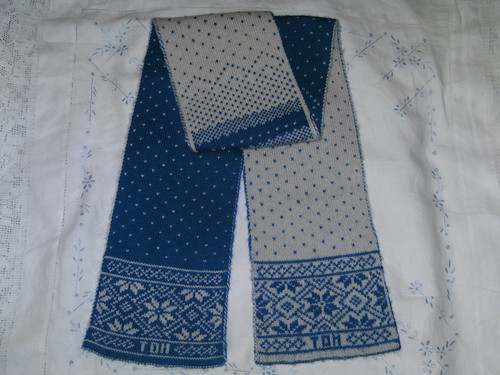
Firstly, I did finish Tom's scarf during the Christmas break, so he has been able to benefit from it's super-warmth during the recent snow!

Christmas knitting 001

One skein of my indigo-dyed yarn made this Swallowtail Shawl designed by Evelyn Clark(this one is for me!):

Swallowtail Shawl 003

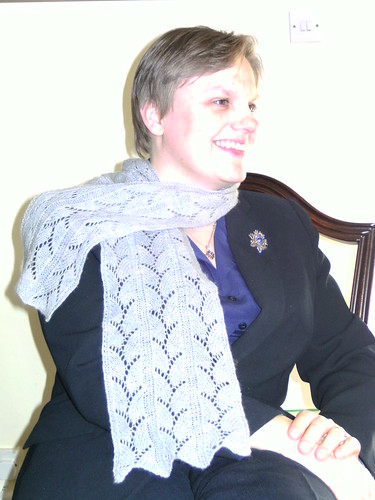
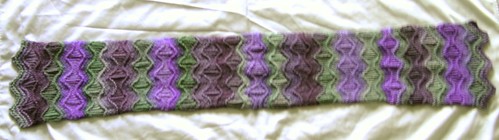
Another skein made this scarf for Mum (modelled by my dear twin-sister). I found the pattern on Ravelry - it's called 'The Waltz':

Mum's scarf

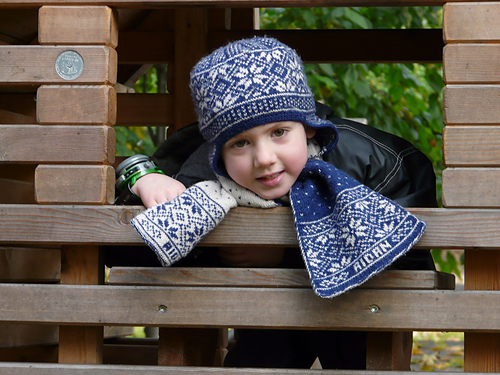
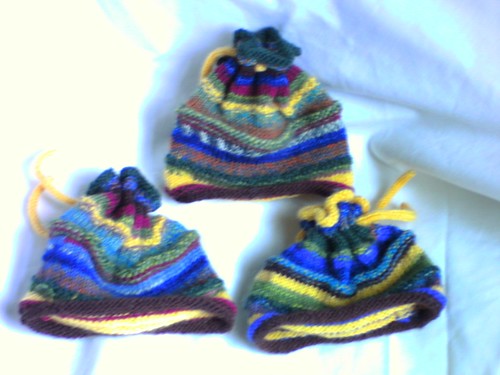
Odd sock yarn remnants made these hats for Bonnie Babies (UK Special Care Baby charity). They are based on a design by my wonderful Danish knitting friend, Kaae:

Hats for SPEW

The yarn I span with wool from Freyalyn made this 'Morning Surf Scarf' from Spin-off magazine:

Morning Surf Scarf

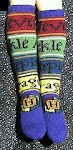
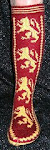
And I finally knitted the Ravenclaw Quidditch Socks from Charmed Knits that I've been lusting after since I got the book from my son last Christmas:

Quidditch socks

Next post - 'On the Needles' - embarrassingly more projects than permitted by my usual '5 or less' rule of thumb!

Saturday, 7 February 2009

And then there were three...

Columns in my blog, that is! I've used a wonderful online tutorial to edit the template setting so that I could add the sidebar you see on the right. That way I can now make a better job of showcasing my patterns. Because the tutorial was so clear this was a lot easier than I anticipated.

Wednesday, 4 February 2009

Double Knitted Bookscarves

I've spent a lot of time before Christmas and in January working on my skills in double knitting (see the video tutorial in the advanced techniques section at knittinghelp.com for basic instruction). Having progressed to the middle section of Tom's scarf I received in the post a version of it for my nephew, made by a Danish knitting friend, Heidi Bybeckmann. This scarf was so beautiful and so perfectly executed that it sent me to my needles to swatch, swatch, swatch in an attempt to emulate her amazing skill. However, only after seeking advice from the Master Knitter herself did I manage to recreate the beautiful corded edges and approach anywhere near her even tension. My two-handed yarn management (which I swear by for fairisle) was not working well for double knitting, and my single-stranded edge stitches were making the edges messy.
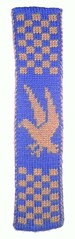
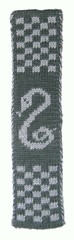
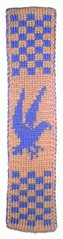
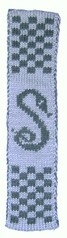
Armed with this new knowledge about how to do double knitting I designed and knitted these Hogwarts bookscarves to practice with:

Fronts:

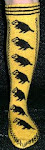
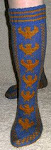
Gryffindor bookscarfHufflepuff bookscarfRavenclaw bookscarfSlytherin bookscarf

Backs:

Gryffindor bookscarf reverseHufflepuff bookscarf reverseRavenclaw bookscarf reverseSlytherin bookscarf reverse

Pattern:

Materials:

4ply/Sock yarn in House Colours as shown Main colour = Colour A, Contrast colour = Colour B
2mm needles

Instructions:

Cast on: Make 18 stitches in each of the two colours for the bookscarf (36 stitches in total), alternating the colours with every stitch. Any two-colour cast-on will do. (I do a very fiddly thing with Judy's magic-cast on to make a cast-on that looks like the back and front were knitted as one long piece and then just folded and seamed at the edges. I'll explain that technique in another post.)

First row: Slip the first stitch knitwise, then alternate knit then purl stitches as when working K1P1 rib, but work all the knit stitches with Colour A, and all the purl stitches with Colour B until the last stitch. Purl the last stitch with both colours held together.

Second and subsequent rows: Slip the first (doublestranded) stitch knitwise. Working a knit stitch first again alternate knit and purl stitches, but working the stitches in whichever colour is required as follows:
On the right side work all knit stitches in the colour shown on the chart, following each knit stitch with a purl stitch in the other colour (i.e. not the colour that was used for the knit stitch). On wrong sides work all the knit stitches in the opposite colour to that shown on the chart following each knit stitch with a purl stitch in the other colour (i.e. not the colour that was used for the knit stitch).
Purl the last stitch with both strands held together.

Cast off: Any cast off will do. I like to separate the stitches so the stitches from each side are on different needles, then graft the two sets of stitches together with Kitchener stitch.

Weave in all ends, and you're done!

Charts: (these link to my flick account - please feel free to download larger versions of the charts from there for your own, non-commercial use)

Bookscarves

Enjoy your Potter reading!

Sunday, 26 October 2008

Indigo

Yesterday I finally got round to using some of the stuff we sowed and planted in spring at the allotment for me to try some natural dyeing with.

When I know something is going to take all day, I need some kind of spur to actually get on with it! In this case it was the fact that natural dyeing with plantstuff is this month's assignment for Herbology in the Harry Potter Knitting and Crochet House Cup. So I asked Dave to harvest the leaves from two of the Japanese Indigo plants while I set up the kitchen for the task ahead so that I could get the leaves into hot water as soon as he brought them in.

My sister was here and took lots of photos of the process for me to share. I followed instructions in Rita Buchanan's fantastic little dyeing book 'A Dyer's Garden':

1) I covered the leaves with hot water in Kilner jars and put them in a big pan of water, then slowly heated them up to 160 degress F over two hours.

Indigo Dyeing 001

2) I strained the liquid off, and squeezed as much as I could from the leaves:

Indigo Dyeing 002Indigo Dyeing 003

3) I added some soda ash to make the solution alkaline:

Indigo Dyeing 006

4) The mixture had to be poured back and forth between containers to aerate it - this apparently releases the pigment, and it did turn a more blue colour as I did this:

Indigo Dyeing 008

5) I added some Spectralite (a 'reducing agent'), then heated the dyebath to 120 degrees F for an hour before putting the first skein in. The dyebath had now turned a greenish yellow colour:

Indigo Dyeing 009

6) I left each skein (I did three consecutively) in the hot bath for 30 minutes. I was thoroughly excited by how the skeins changed from yellow to blue when I took them out, it took seconds rather than minutes, and they went through a marvellous turquoise moment on the way:

Indigo Dyeing 010

The same skein seconds later (though it was less bright than the picture shows):

Indigo Dyeing 011

After hanging the skeins to air for at least half an hour I washed them, then re-skeined them (they had felted a little in the process). This is how they ended up - beautiful soft tones of French blue, grey and silver. The top skein shows the bare yarn I started with - a laceweight lambswool from Texere:

Indigo Dyeing 024

An awesome experience!!

Dave is so enthused by this he has created a raised bed at the allotment just for my dyeplants!

Friday, 3 October 2008

Sheep Spotter!!

Masham Sheep Fair was fantastic!!! I went with my sister and we had lots of fun ogling the sheep and all the various stalls. Marie was so inspired by the displays in the schoolroom where Bradford and Craven Guilds have stalls that she bought some fibre from Adelaide Walker, has borrowed a spindle from me, and has now learned spindle-spinning. I'm avsolutely delighted because last year she gave up in disgust after only a few minutes with my spindle during our camping holiday. She has now spun at least 25g of her lovely mixed blue merino top.


The biggest treat for me was finding a little pocket-sized 'Know You Sheep' book - recently published. It is going everywhere in my handbag because I am indeed a sad little wool addict and really want to be able to identify every sheep that I meet. I've been this way since my teens, and do now know many brreds by sight. I struggle with Blackface and Swaledale and Lonk though - they are so similar. While the Swaledale has only a grey muzzle, the markings on a Blackface or Lonk can take that configuration anyway, and Lonks and Blackfaces of any markings seem indistinguishable. And if I ever come acvroos some 'down' sheep I'll also be in trouble because they all look virtually identical too! Ah well...!!


Marie drove, so I was able to get some knitting done on the journey, and am pleased to report that I have now finished Tom's Hogwarts Socks. I've just to finish writing up the pattern and then I'll publish. Alas, I haven't got a decent photo yet -the flash has made the purple cuff and foot look blue. The text says 'Never Tickle A Sleeping Dragon' - the Hogwarts school motto!!


Monday, 22 September 2008

Advancing skills?

At last all the children, including my sister's children, are in full-time school. Instead of using the extra time this frees up for housework I have, of course, been doing more spinning and knitting! It really is addictive, and I am well and truly hooked! Especially as during the last week I have been doing new things - styles and techniques I've never or rarely tried before.

First off I finished the Quidditch yarn - 300g of BFL spun to 'worsted' weight (roughly aran). I got 350 yards, and was reasonably happy with the results as I have rarely spun such thick yarn before. It turned out more consistent than I thought it would be. An unexpected element was added when I discovered that bonus points were available for metallic looking metal colours. How is Hufflepuff black a metallic colour? Well, apparently black is associated with iron in heraldry. Going with this I felt there was grounds for a hint of gold in the yarn, as 'fools gold' is really iron pyrites, so I plied the singles with some gold filament thread I have. It looked great. especially after dyeing the yarn black - the metallic thread didn't take the dye, so the gold glints really stand out. First picture is before dyeing:


Handspun 003


Handspun 007

In order to free up bobbin space for the Hufflepuff yarn I also plyed the singles I spun at Alston Hall from some dyed roving I bought from Freyalyn - her Wisteria colourway. I decided to Navajo ply because I wanted to maintain lengths of solid colour. This felt very brave because my last go at Navajo plying was very bumpy!! However, this time the yarn does not have bumps where each chain meets - those points are barely discernable. I thought I had overplyed as the skeins twisted so much when I took them off the niddynoddy, but after an intersesting discussion with Penny Leonard at Guild on Saturday I found that the yarn did indeed relax so much after washing that the skeins no longer self-twist. Perhaps my last Navajo-plyed yarn was so bumpy because it was underplyed?

Here is a section of the skeins as they hang to dry, and a full shot of them (sadly the colours don't show well - they are much more vibrant in real life):

Handspun 018


Handspun 021

And finally, my new knitting craze - I have been learning double-knitting. This is not in this case a yarn thickness, but a knitting technique that creates double-sided knits. I first came across the technique when I saw an article about double-knitted socks which solved the mystery from 'Knitting in the Nordic Tradition' about how the nurse in War and Peace knitted two socks in one. Then a friend of mine knitted a two-colour double-knitted bag, and I realised the possibilities double-knitting affords for colourwork. I wondered if this would resolve my problem with Aidan's scarf, knitted as a fairisle tube, which was turning out far too thick. So, I researched the technique and cast on. It works!! I am knitting a scarf that has a design on both sides, yet only uses two strands of yarn, and is a perfect thickness. The biggest win was getting the name (this one is for my middle son, Tom) to read properly on both sides. The scarf so far:

Double-knitted scarf 020


Double-knitted scarf 023

Clever eh?

Monday, 15 September 2008

Made it!

Ok - I'm a fast knitter! I am regularly accused of this in Ravelry due to the rate at which I add finished projects. This week I managed to knit a whole jumper in just five days! Before you faint with exhaustion at the thought I'd better add that it was for a child - it started life on my needles as a jumper for my middle son, and came off the needles a better fit for my youngest, who now owns it. What I'm proud of is that I've finally mastered my Mum's skill of knitting while watching T.V. (or in my case, while reading the computer screen!) - I feel like I have 'made it' as a knitter!

The well-read among you will immediately recognise that this is a Weasley jumper. Indeed I knitted it as my Transfiguration 'homework' for the 'Harry Potter Knitting and Crochet House Cup'. We had to do something that would be a good learning process - something we hadn't done before, and were supposed to do a Potter-themed pattern to boot. I went for the sweater because I have rarely knitted them - mostly due to hating seaming. Hence this is a seamless, top-down sweater! I love the technique and think I will be doing many more, and learning more about sizing in the process.

Tom's jumper 010

My youngest son will also be the beneficiary of a glove design I am currently working on. I charted the pattern a year ago, intending to knit it to go with the Nordic earflap hats I made for my boys and my nephew and niece last Christmas. Fortunately for this design there is an astronomy class in the House Cup for which we have to do a star-themed knit, and that supported me to actually get on and knit these. They are a combination of Nordic and Yorkshire design, patterned, fingered gloves with names on being a traditional knit in Yorkshire in times gone by. I need to tweak the pattern a little, then I will publish it. At the moment the index finger is disproportionately long:

Star gloves 004

Star gloves palm

As well as all this 'homework' I also have Quidditch practice to do because I'm a Beater in the Hufflepuff Quidditch team. The game consists of creating a knitted or crocheted item as a team effort, with the 'Seeker' doing the design work, two 'Beaters' spinning the yarn, three 'Chasers' knitting/crocheting it, and a Keeper doing the finishing! My job is to spin 300 yards of aran-weight wool, then dye it black. Tough call, as I have rarely spun anything thicker than sock-weight! Anyhow, I've spun the singles - perhaps a little overspun - spot the snarls! Tomorrow I shall ply.

Handspun 002


And finally, here is the promised picture of the cardigan I knitted for Poppy. The pattern is one I found in Ravelry, based on one Lucy wears in the first Narnia film:

Vesty thing and Poppy's cardigan 003